MIT Center for Coordination Science
m_klein@mit.edu
Chrysanthos Dellarocas
MIT Sloan School of Management E53-315
dell@mit.edu
In this paper we will review the limitations of current "agent-local" approaches to exception handling in agent systems, and propose an alternative "shared service" approach that offers simplified agent development as well as more effective and easier to modify exception handling behavior. Initial versions of this service have been developed and tested in the multi-agent collaborative design conflict management domain; we will describe our preliminary results as well as our future plans.
A few efforts have done some preliminary exploration of the use of distinct exception handling services. This work has occurred predominantly in the context of business process enactment (Kreifelts and Woetzel 1987; Auramaki and Leppanen 1989; Karbe and Ramsberger 1990; Strong 1992; Mi and Scacchi 1993), manufacturing control (Parthasarathy 1989; Katz 1993; Visser 1995) and planning (Broverman and Croft 1987; Birnbaum, Collins et al. 1990). The process enactment and manufacturing work, in general, has either not evolved to the point of constituting a computational model, or has been applied to a very limited range of domains (e.g. just software engineering or flexible manufacturing cell control) and exception types (e.g. just inappropriate task assignments). The planning work, by contrast, has developed a range of computational models but their ability to redesign a multi-agent work process in response to an exception is contingent upon the planning approach having been used to develop the original work process. This requirement is difficult or impossible to satisfy in an environment where the work process emerges dynamically via the interaction of multiple heterogeneous agents.
Generic Exception Handling Expertise: The key element underlying our approach is the simple but powerful notion that generic and reusable exception handling expertise can be usefully separated from the knowledge used by agents to do their "normal" work. There is substantial evidence for the validity of this claim. Early work on expert systems development revealed that it is useful to separate domain-specific problem solving and generic control knowledge (Barnett 1984; Gruber 1989). Analogous insights were also confirmed in the domains of collaborative design conflict management (Klein 1991) and in preliminary work on process exception management (Klein 1997). Generic exception management strategies are easy to find (Klein 1989). Some examples include:
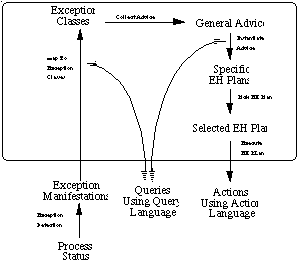
Heuristic Classification: A useful metaphor for organizing such
expertise, we have found, is to treat exception handling (EH) as a heuristic
classification process (Clancey 1984) analogous to that used in medical
diagnosis. In this approach, an exception manifestation (i.e. symptom),
once detected, is mapped to candidate diagnoses in a pre-defined taxonomy
of generic underlying causes; generic strategies associated with these
diagnoses are then instantiated into candidate exception resolution plans,
one of which is then selected and executed:
The approach thus instantiates generic exception handling expertise into specific situations. The EH service communicates with agents using pre-defined languages for learning about the exception(s) (the query language) and for describing exception resolution actions (the action language). Agents can take any form as long as they are capable of responding appropriately to at least a minimum subset of these query and action languages.
Exception Detection: The first step in detecting exceptions is, of course, having a model of what the "correct" behavior for the multi-agent system is. When an agent is introduced into a multi-agent system, therefore, it must register at least a rudimentary model of its normative behavior with the exception handling service. This model is mapped to a list of the failure modes that are known to occur for that kind of normative behavior, and sentinels are generated to detect those modes.
Failure mode identification is done making use of a taxonomy of generic problem solving processes wherein each process is annotated with the different ways it can fail. When a new agent is registered, we merely identify the generic processes corresponding to that agent's behavior, and derive the applicable failure modes from that. For example, it is typical for agents to require the output of another agent. The processes for managing such "flow" dependencies need to make sure that the right thing gets to the right place at the right time (Malone and Crowston 1994). This immediately implies a set of possible failure modes including an input being late ("wrong time"), of the wrong type ("wrong thing") and so on. Similar analyses can be done for other generic processes, e.g. resource sharing, diagnosis, synthesis, market-based coordination and so on. We are building for this purpose upon the process taxonomy being developed in the context of the MIT Process Handbook. The Handbook is a substantive (3700+ entity) and growing repository of coordination mechanisms and other problem solving processes (Malone, Crowston et al. 1993; Dellarocas, Lee et al. 1994; Malone and Crowston 1994) which has been under development for roughly the past five years in the MIT Center for Coordination Science.
Our work to date in performing failure mode analysis has revealed a wide range of exception types (Klein 1997). Exceptions in general involve violations of some either implicit or explicit assumption underlying a collaborative work process (e.g. stability of resources, correctness of output etc.) and can include change in resources, organizational structure, agent system policies, task requirements or task priority. They can also include incorrectly performed tasks, missed due dates, resource contentions between two or more distinct processes, unexpected opportunities to merge or eliminate tasks, conflicts between actions taken in different process steps and so on.
Every failure mode can have associated with it a script that searches for the pattern of agent behavior corresponding to that failure. These scripts, once instantiated, play the role of "sentinels" that alert the exception handling service when the condition they were created to detect has occurred. A typical sentinel, for example, may check for a task becoming late, violation of resource limits, circular wait patterns, and so on. To define these scripts, we build upon pattern matching tools developed in previous work (Klein 1997).
Exception Diagnosis: The diagnosis mechanisms works by traversing a taxonomy of possible exception diagnoses based on the presenting symptoms as well as information about the process model being enacted. This is a "shallow model" approach (Chandrasekaran and Mittal 1983) because it is based on compiled empirical and heuristic expertise rather than first principles. This approach is appropriate for domains, such as medical diagnosis, where complete and consistent first-principle-based behavioral models do not exist. An important characteristic of heuristic classification is that the diagnoses represent hypotheses rather than guaranteed deductions: multiple diagnoses may be suggested by the same symptoms, and often the only way to verify a diagnosis is to see if the associated prescriptions are effective.
The diagnosis hierarchy, in our current model, is structured as a decision tree wherein the system starts at the top most abstract diagnosis and attempts to refine it to more specific diagnoses by traversing down the tree and selecting the appropriate decision branches by asking questions, expressed as query language statements, of the relevant problem solving agents. For example, if the system is assessing whether the diagnosis of "circular wait deadlock" applies, it may ask agents for which other agents they are waiting for inputs from. This traversal can result in more than one candidate diagnosis, since multiple causes may be suggested by the same symptoms.
Exception Resolution: Once one or more candidate diagnoses for an exception have been identified, the next step is to generate, using a knowledge base of generic exception resolution strategies, specific plans for resolving the problem. A diagnosis class will often have several potential resolution strategies. Since they may not all be applicable for a particular exception, a decision tree procedure identical to that used to select diagnoses is used to find the generic strategies for a given diagnosis. Strategies are represented as executable script templates whose actions are described using the action language. Every template has "slots" which are filled with context-specific values, found using query language queries, to produce specific exception resolution plans. The resolution strategy "backtrack to untried plan for goal", for example, would include slots for the goal and plan that are filled in by asking the affected agent what goal is was trying to achieve, and what other plans are available for achieving that same goal. Typically, many possible candidate plans can be generated for a given exception. We can backtrack, for example, in as many ways as there are alternative plans. In our previous work we have found that a relatively small collection of domain-independent heuristics (e.g. "pick the plan that makes the smallest change") has been effective in producing a useful ranking of candidate exception resolution plans.
The Query and Action Languages: As we have seen, the query and action languages represent the medium by which the exception handling service interacts with the problem solving agents to detect, diagnose and resolve exceptions. The query language is used to get agent state information, and the action language is used to modify it.
The query language we use builds upon that developed in earlier systems (Klein 1989; Klein 1993) extending it to include queries concerning normative agent behavior models. The query language is relatively large, and we will make the effort to consolidate it into a smaller set of critical query types. The action language, in contrast, consists we have found of a relatively small set of operators (Klein 1989). These include changing the process model (re-ordering, deleting or adding new tasks; changing the resources allocated to a task; canceling tasks) and changing the work package contents.
Our experience to date has shown that agents do not have to understand all of the query or action language primitives in order to benefit from the exception handling service, but the more primitives they can understand, the more effective the exception handling service is likely to be. This is because the more generic exception diagnoses and resolution strategies tend to require only the simplest and easiest to implement queries and actions, but the more sophisticated (and presumably more effective) diagnoses and resolutions use the more "advanced" primitives.
The query and action languages can be viewed as representing a "price of admission" to our approach. These languages only require, however, that the individual problem solving agents be able to describe their own behavior as well as a modify their own actions; the exception handling service is responsible for understanding how local knowledge and actions can be coordinated to produce a globally effective exception response. Previous DAI research suggests, moreover, that for many cases we want our agents to have roughly that level of self-awareness and self-modifiability in order to support effective coordination even in the absence of exceptions (Findler and Lo 1988).
System Architecture: The capabilities described above can be implemented straightforwardly as agents that can simply be plugged-in to an existing agent system with suitable interfaces:
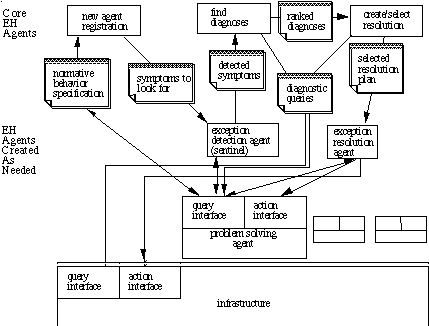
This architecture consists of exception handling agents, problem solving agents as well as the agent systems infrastructure, all of which must support at least the base level query and action languages. When a new agent is created, the "new agent registration" agent takes a description of its normative behavior and creates sentinels (exception detection agents) as necessary to look for evidence of dysfunctional behavior. Should a sentinel detect such symptoms, this information is sent to a "diagnosis" agent which produces a ranked set of candidate diagnoses. These in turn are sent to the resolution agent which defines a resolution plan instantiated in the form of a "resolution" (exception resolution) agent. We can have redundant copies of these agents, thereby increasing performance and addressing potential failures in the exception handling agents themselves.
Human in the Loop: While the architecture above has been presented as a fully automated one, in at least some cases it will make sense to include a human "executive manager" in the loop. Our previous work in this area, for example, used human input to modify the ranking of diagnoses and resolution plans proposed by the exception handling service, and thereby direct the system in the direction the human users considered more appropriate (Klein and Lu 1991). We have found that the exception handling service can help human users better understand and more creatively resolve exceptions, even if they did not use the particular resolutions proposed by the system.
|
|
|
|
| conflict detection strategies | ~10 |
|
| query operators in standardized agent communication language | ~100 |
|
| action operators in standardized agent communication language | ~10 |
|
| exception diagnoses | ~100 |
|
| exception resolution strategies | ~300 |
|
| exception plan selection heuristics | ~10 |
|
Our results to date suggest that the exception handling service approach enables two classes of important benefits:
Technical issues we currently consider important include extending the diagnostic approach to be able to handle multiple simultaneous exceptions in a coordinated way (Wu 1990), as well as reducing as much as possible the size of the query/action languages that agents need to understand in order to interact effectively with the exception handling service. We also plan to explore "model-based" diagnostic approaches (Genesereth 1982; Kleer, Macworth et al. 1990) which have been applied with good results to explaining faults in that subclass of systems where complete behavioral models exist
Our evaluation plan consists of a graded series of experiments, occurring first in a simulated agents testbed (where we have the maximum flexibility in designing the test scenarios), and then transitioning to an externally developed testbed (to assess and demonstrate the ability to extend a pre-extending agent system with our exception handling technology). The simulated testbed will evaluate agent system behavior using such heuristics as problem solving time, effectiveness of resource utilization, the understandability of the agent ensemble behavior to human observers, ability of problem solving agents to work in multiple ensemble contexts w/o modification, and the ability to control the tradeoff between exception handling and problem solving effort. We currently plan to do our first tests in the manufacturing logistics domain. The second testbed will enable a "technology integration experiment" wherein we explore integration of our exception handling technology into a agent system not originally designed for that purpose. This will allow us to assess and demonstrate the ability of our technology to be "plugged in" to other testbeds, help us identify the knowledge base and query/action language enhancements needed, if any, and provide insights into how integration can best be done. We can therefore view this as a "final rehearsal" for adoption of our technology by agent system developers outside of our project team. We are currently considering, for this purpose, the MIT AI Lab's "Intelligent Room", a large real-time agent-based information gathering/presentation system (Kautz, Selman et al. 1994; Coen 1997; Coen 1997).
See http://ccs.mit.edu/ases/ for more information about our project.
Barnett, J. A. (1984). "How Much Is Control Knowledge Worth? A Primitive Example." Artificial Intelligence 22(1): 77-89. Describes the value of separating control and domain problem solving knowledge.
Birnbaum, L., G. Collins, et al. (1990). Model-Based Diagnosis of Planning Failures. AAAI-90. Describes a model-based approach to diagnosis (as opposed to heuristic classification).
Broverman, C. A. and W. B. Croft (1987). Reasoning About Exceptions During Plan Execution Monitoring. AAAI-87. Describes exception handling where an exception is defined as when a human agent does not perform an action the system expects him/her to (i.e., does not perform a primitive action whose precedents have all been successfully performed).
Chandrasekaran, B. and S. Mittal (1983). "Deep Versus Compiled Knowledge Approaches To Diagnostic Problem Solving." Int. J. Man-Machine Studies: 425-436. Distinguishes deep vs compiled forms of knowledge an dtheir tradeoffs whenused for problem solving.
Clancey, W. J. (1984). "Classification Problem Solving." Aaai: 49-55.Describes the abstract structure of heuristic classification.
Coen, M. (1997). Building Brains for Rooms: Designing Distributed Software Agents. Proceedings of IAAI-97. Describes the MIT Intelligent Room project.
Coen, M. (1997). Towards Interactive Environments: The Intelligent Room. Proceedings of HCI-97. Describes the MIT Intelligent Room project.
Dellarocas, C., J. Lee, et al. (1994). Using a Process Handbook to Design Organizational Processes. Proceedings of the AAAI 1994 Spring Symposium on Computational Organization Design, Stanford, California. Describes the use of the Process Handbook for template-based process design.
Findler, N. V. and R. Lo (1988). An Examination of Distributed Planning in the World of Air Traffic Control. Readings in Distributed Artificial Intelligence. A. H. Bond and L. Gasser. California, Morgan Kaufmann: 617--627. Describes distributed planing algorithms, identifying the capabilities agents need to have in order to participate effectively in this.
Genesereth, M. R. (1982). Diagnosis Using Hierarchical Design Models, Proceedings of AAAI-82 Describes a kind of model-based diagnosis.
Gruber, T. R. (1989). "A Method For Acquiring Strategic Knowledge." Knowledge Acquisition 1(3): 255-277. Describes the utility of maintaining control knowledge distinct from problem solving knowledge.
Karbe, B. H. and N. G. Ramsberger (1990). Influence of Exception Handling on the Support of Cooperative Office Work. Multi-User Interfaces and Applications. S. Gibbs and A. A. Verrijin-Stuart, Elsevier Science Publishers: 355-370. Describes an electronic circulation folder approach to exception handling in office settings.
Katz, D. M., S. (1993). Exception management on a shop floor using online simulation. Proceedings of 1993 Winter Simulation Conference - (WSC '93), Los Angeles, CA, USA, IEEE; New York, NY, USA. Describes the use of on-line simulation to detect exceptions in manufacturing shop contexts.
Kautz, H., B. Selman, et al. (1994). An Experiment in the Design of Software Agents. Proceedings of the Twelfth National Conference on Artificial Intelligence (AAAI-94), Seattle, WA. Describes the MIT Intelligent Room project.
Kleer, J. d., A. K. Macworth, et al. (1990). Characterizing Diagnoses. Proceedings of AAAI-90. Describes model-based diagnosis.
Klein, M. (1989). Conflict Resolution in Cooperative Design. Computer Science. Urbana-Champaign, IL., University of Illinois. PhD thesis describing an implemented multi-agent system for conflict resolution in collaborative LAN design.
Klein, M. (1991). "Supporting Conflict Resolution in Cooperative Design Systems." IEEE Systems Man and Cybernetics 21(6): 1379-1390. Describes conflict resolution algorithms used in thesis work.
Klein, M. (1993). "Capturing Design Rationale in Concurrent Engineering Teams." IEEE Computer 26(1): 39-47. Describes a rich rational ecapture language designed for collaborative design settings.
Klein, M. (1993). "Supporting Conflict Management in Cooperative Design Teams." Journal on Group Decision and Negotiation 2: 259-278.Describes extension of conflict management approach to settings with human designers.
Klein, M. (1995). "Conflict Management as Part of an Integrated Exception Handling Approach." AI in Engineering Design Analysis and Manufacturing (AI EDAM) 9: 259-267. Describes an extension of the conflict management work to the larger world of exception handling.
Klein, M. (1996). "Core Services for Coordination in Concurrent Engineering." Computers in Industry. Describes core coordination services for collaborative design, including exception handling.
Klein, M. (1997). "An Exception Handling Approach to Enhancing Consistency, Completeness and Correctness in Collaborative Requirements Capture." Concurrent Engineering Research and Applications(March).Describes the detection and resolution of exceptions in colaborative requirements definition.
Klein, M. (1997). Exception Handling in Process Enactment Systems. Cambridge MA, MIT Center for Coordination Science. CCS WP 203.Describes exception handling in workflow settings.
Klein, M. and S. C.-Y. Lu (1991). Insights Into Cooperative Group Design: Experience With the LAN Designer System. Sixth International Conference on Applications of Artificial Intelligence in Engineering (AIENG '91), UK. Describe sinsights into collaborative design derived from empirical studies in PhD work.
Kreifelts, T. and G. Woetzel (1987). Distribution and Error Handling in an Office Procedure System. IFIP WF 8.4 Working Conference on Methods and Tools for Office Systems, Pisa Italy. Describes some simple exception handling extensions to the DOMINO workflow system.
Malone, T. W., K. Crowston, et al. (1993). Tools for inventing organizations: Toward a handbook of organizational processes. Proceedings of the 2nd IEEE Workshop on Enabling Technologies Infrastructure for Collaborative Enterprises (WET ICE), Morgantown, WV, USA. Describes key concepts underlying the Process Handbook, a repository for process knowledge based on taxonomic principles.
Malone, T. W. and K. G. Crowston (1994). "The interdisciplinary study of Coordination." ACM Computing Surveys 26(1): 87-119.Provides additional details on the Hsndbook concepts, focusing especially on dependency and coordination mechanism types.
Mi, P. and W. Scacchi (1993). Articulation: An Integrated Approach to the Diagnosis, Replanning and Rescheduling of Software Process Failures. Proceedings of 8th Knowledge-Based Software Engineering Conference, Chicago, IL, USA, IEEE Comput. Soc. Press; Los Alamitos, CA, USA. An exception handling approach applied to several exception types in the software engineering domain.
Parthasarathy, S. (1989). Generalised process exceptions-a knowledge representation paradigm for expert control. Proceedings of the Fourth International Conference on the Applications of Artificial Intelligence in Engineering, Cambridge, UK, Comput. Mech. Publications; Southampton, UK. Describes an approach to handling timing exceptions in a manufacturing domain.
Strong, D. M. (1992). "Decision support for exception handling and quality control in office operations." Decision Support Systems 8(3). Describes requirements for exception handling in office settings, based on empirical studies.
Suchman, L. A. (1983). "Office Procedures as Practical Action: Models of Work and System Design." ACM Transactions on Office Information Systems 1(4): 320-328. Identifies the importance of exceptions in office work.
Visser, A. (1995). "An exception-handling framework." International Journal of Computer Integrated Manufacturing 8(3): 197-203. Proposes a framework for representing exception handling knowledge.
Wu, T. D. (1990). Efficient Diagnosis of Multiple Disorders Based on a Symptom Clustering Approach. Proceedings of AAAI-90 Describes an enhancement to standard heuristic classification techniques that can diagnose multiple simultaneous diseases with symptom interactions.