


One might ask if the experiments described above could be modified to determine
the ``true'' coordinate system used by motor cortex to describe hand
movement direction. However, I claim that
for certain classes of distributed representation this is not a
well-defined question. Distributed representations of measured variables
can be coordinate-free
in the sense that they do not imply any particular coordinate system.
To see this, let X be any variable represented in cortex (such as hand
movement direction),
and let  be a vector-valued function representing the outputs of a
large set of basis functions
be a vector-valued function representing the outputs of a
large set of basis functions  which describe the behavior of
(motor) cortical cells.
which describe the behavior of
(motor) cortical cells.  is then a
distributed representation of the variable X. Now, consider a vector
function
is then a
distributed representation of the variable X. Now, consider a vector
function
 which measures X in a particular
coordinate system (
which measures X in a particular
coordinate system ( might give the 3 Cartesian components of hand
movement direction,
for example). If there exists a matrix H such that
might give the 3 Cartesian components of hand
movement direction,
for example). If there exists a matrix H such that 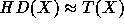 ,
then one can say that the distributed representation D codes the
coordinate system T. Yet this will hold for any
,
then one can say that the distributed representation D codes the
coordinate system T. Yet this will hold for any  which is close to
the linear span of the basis functions
which is close to
the linear span of the basis functions  , so we cannot claim that
D encodes any single coordinate system for X within this span better
than another.
, so we cannot claim that
D encodes any single coordinate system for X within this span better
than another.