


Consider a scalar variable x that represents some measurable external
quantity. Suppose that sensory processing encodes the variable x over a
population of cells 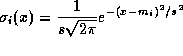 such that each cell has a
localized
``receptive field'' for values of x. For example, we could use a
Gaussian shaped receptive field such as
such that each cell has a
localized
``receptive field'' for values of x. For example, we could use a
Gaussian shaped receptive field such as

where the standard deviation s determines the specificity and overlap of
the receptive
fields, and the means  determine the centers. Then any value of x
is represented as a local pattern of
activity over the set
determine the centers. Then any value of x
is represented as a local pattern of
activity over the set  .
.
Now, define  to be a noisy measured value of x with
additive
independent random noise
to be a noisy measured value of x with
additive
independent random noise  . Let the probability distribution of
 be equal to the receptive field shape
  . For example, if
 is as above, then let
  be Normal with variance
  .
Then we have
.
Then we have

In other words, each basis function output can be interpreted as the
probability that the
noisy measurement  was in fact generated by the uncorrupted value
 . The value of
  for which
  is maximized is
the maximum likelihood (ML) estimate of x given
is maximized is
the maximum likelihood (ML) estimate of x given  .
.
We can compute the maximum a posteriori (MAP) estimate of x given
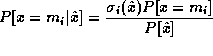 using Bayes' rule:

Note that this is proportional to  if
if  and
and
 are uniform. In this case, the set
of
are uniform. In this case, the set
of  's gives the probability density of
x for each measurement
's gives the probability density of
x for each measurement  .
.
We can average the basis function outputs over multiple values of x to obtain the expected value:
and this expression gives a smoothed and subsampled version of  . In
particular, if the receptive fields are all the same shape so that
. In
particular, if the receptive fields are all the same shape so that
 , then equation 1
describes sampled values from the convolution
, then equation 1
describes sampled values from the convolution  and approximates
 . Thus the
expected values
. Thus the
expected values  give a sampled and smoothed approximation
to the input
probability density
give a sampled and smoothed approximation
to the input
probability density  in a manner similar to Parzen Windows density
estimation. (
in a manner similar to Parzen Windows density
estimation. ( can also be interpreted as a sampled but not
smoothed version of
can also be interpreted as a sampled but not
smoothed version of  .)
.)
The above analogy provides the theoretical basis for the analysis of this
type of population code. Note that it applies only to population codes
described by local receptive fields. The noise term  is an artificial
theoretical construction that allows the analogy to be made. A receptive
field in the population code corresponds to the noise distribution in the
probability analogy, and a wider receptive field is equivalent to a higher
noise variance.
is an artificial
theoretical construction that allows the analogy to be made. A receptive
field in the population code corresponds to the noise distribution in the
probability analogy, and a wider receptive field is equivalent to a higher
noise variance.
