


Result R4 that there exists a linear combination
of the firing rates which can predict
the Cartesian coordinates of hand motion follows as a direct consequence of
well-known results
on coarse coding and the theory of radial basis functions [Poggio and Girosi 1990, for
example,], since a raised cosine function of angle can be thought of as
a local basis function centered on the preferred direction.
An alternate way to prove this fact follows. Define an
 matrix Q whose rows are the preferred direction vectors
  .
Let D be an N-dimensional column vector formed from the firing rates of
all
the cells by the formula
.
Let D be an N-dimensional column vector formed from the firing rates of
all
the cells by the formula  as in [Georgopoulos et al. 1988].
Then from equation 6
we can write
as in [Georgopoulos et al. 1988].
Then from equation 6
we can write
We seek a 3xN weighting matrix H such that a population vector of the form HD predicts hand direction M according to
There are many matrices H which will satisfy this equation. One possibility is to use linear least-squares regression, giving
where the inverse  will always exist
so long as there are three linearly independent preferred direction vectors.
We now have
will always exist
so long as there are three linearly independent preferred direction vectors.
We now have

as desired. This equation means that so long as there exist
three linearly independent direction vectors,
the hand direction will be approximately linearly related to the cell
firing rates  in any coordinate system for M which satisfies equation
9. So far I have shown that result R1 implies both
results R2 and R4, given the method of analysis.
in any coordinate system for M which satisfies equation
9. So far I have shown that result R1 implies both
results R2 and R4, given the method of analysis.
In [Georgopoulos et al. 1988] the columns of H
were not found by performing a regression of the cell firing
rates against the hand direction according to equation 11,
but instead were assumed a
priori to be equal
to the preferred direction  for each cell, so that
  .
I now discuss under
what conditions result R5 holds, so that
this particular linear combination will give the right answer.
The population vector is given by
equation 2 which we can rewrite in vector
notation as
.
I now discuss under
what conditions result R5 holds, so that
this particular linear combination will give the right answer.
The population vector is given by
equation 2 which we can rewrite in vector
notation as
and if this holds for all directions M then we must have  .
This is a necessary condition for the existence of a population vector.
In [Georgopoulos et al. 1988] a more restrictive sufficient condition
satisfying equation 2 is that
the distribution of preferred
directions is uniform over the sphere. Another necessary and sufficient
condition based
on Fourier analysis of the distribution of preferred directions for
the planar case is given in [Mussa-Ivaldi 1988].
.
This is a necessary condition for the existence of a population vector.
In [Georgopoulos et al. 1988] a more restrictive sufficient condition
satisfying equation 2 is that
the distribution of preferred
directions is uniform over the sphere. Another necessary and sufficient
condition based
on Fourier analysis of the distribution of preferred directions for
the planar case is given in [Mussa-Ivaldi 1988].
To understand the meaning of equation 13, we can write each
component of  as
as

and  implies that
 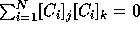 whenever
 . This expression is the correlation of the
  and
and
 components of the preferred direction vectors
  ,
so a necessary and sufficient condition for equation 2 to work
is that
the x, y, and z components of these vectors
are uncorrelated and have equal variance.
The result that equation 2 is satisfied is thus implied by the
approximately uniform distribution of cell preferred directions in result R3.
Note that for other coordinate systems, even
if the components of the
,
so a necessary and sufficient condition for equation 2 to work
is that
the x, y, and z components of these vectors
are uncorrelated and have equal variance.
The result that equation 2 is satisfied is thus implied by the
approximately uniform distribution of cell preferred directions in result R3.
Note that for other coordinate systems, even
if the components of the  's are correlated
there will still exist a linear combination
's are correlated
there will still exist a linear combination  of the firing
rates which will predict the desired values, although the matrix
H may need to be found by regression using equation 11.
But if both results R1 and R3 hold, then result R5 must hold.
of the firing
rates which will predict the desired values, although the matrix
H may need to be found by regression using equation 11.
But if both results R1 and R3 hold, then result R5 must hold.
Suppose that rather than using the predicted value QM we use the true measured value D and this includes significant non-cosine (nonlinear) terms. Then we have

where E is a vector with components

If the terms  and
and  are distributed independently of
the components of
are distributed independently of
the components of  , then
  and these terms will not affect
the value of the population vector. So even if
the individual cells do not have cosine tuning,
the population vector will correctly predict hand direction
if the terms for k>1 do not correlate with the terms for k=1 in the
expansion given in equation 7.
and these terms will not affect
the value of the population vector. So even if
the individual cells do not have cosine tuning,
the population vector will correctly predict hand direction
if the terms for k>1 do not correlate with the terms for k=1 in the
expansion given in equation 7.
If the experiments are repeated with differing initial positions as in
[Caminiti et al. 1990], then the preferred directions  may
change.
This will lead to a new matrix
may
change.
This will lead to a new matrix  so that
  . Population vector
analysis under the new conditions will give
. Population vector
analysis under the new conditions will give 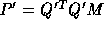 , so again the
requirement for success is that the components of the new preferred
directions are uncorrelated. The fact that population vectors
``proved to be good predictors of movement direction regardless of where in
space the movements were performed'' [Caminiti et al. 1990, page 2039,] provides no
information beyond the knowledge that the components of the preferred
directions remain uncorrelated as the initial hand position changes.
, so again the
requirement for success is that the components of the new preferred
directions are uncorrelated. The fact that population vectors
``proved to be good predictors of movement direction regardless of where in
space the movements were performed'' [Caminiti et al. 1990, page 2039,] provides no
information beyond the knowledge that the components of the preferred
directions remain uncorrelated as the initial hand position changes.



